
Lighting the Woodland School at Kinsman Robinson Galleries
“What makes this show better than the last one? It’s not more artwork. It’s not better quality art. It’s the ability to light it up.”
John Newman, Associate Director, Kinsman Robinson Galleries
For several decades, Kinsman Robinson Galleries was one of Toronto’s most prestigious fine art galleries, located in Yorkville and representing some of Canada’s leading artists including four holders of the Order of Canada, and the most significant body of work by Norval Morrisseau, founder of the Woodland School of Indigenous art.
In 2012, KRG converted the entire 2,000 square feet of their multi-level gallery from halogen lighting to Lumicrest LEDs. With works on the walls regularly valued at over $100,000, the decision to retrofit with a then-new technology was anything but casual. Associate Director John Newman didn’t view it as a gamble, he viewed it as a necessary, considered investment in the success of the gallery.
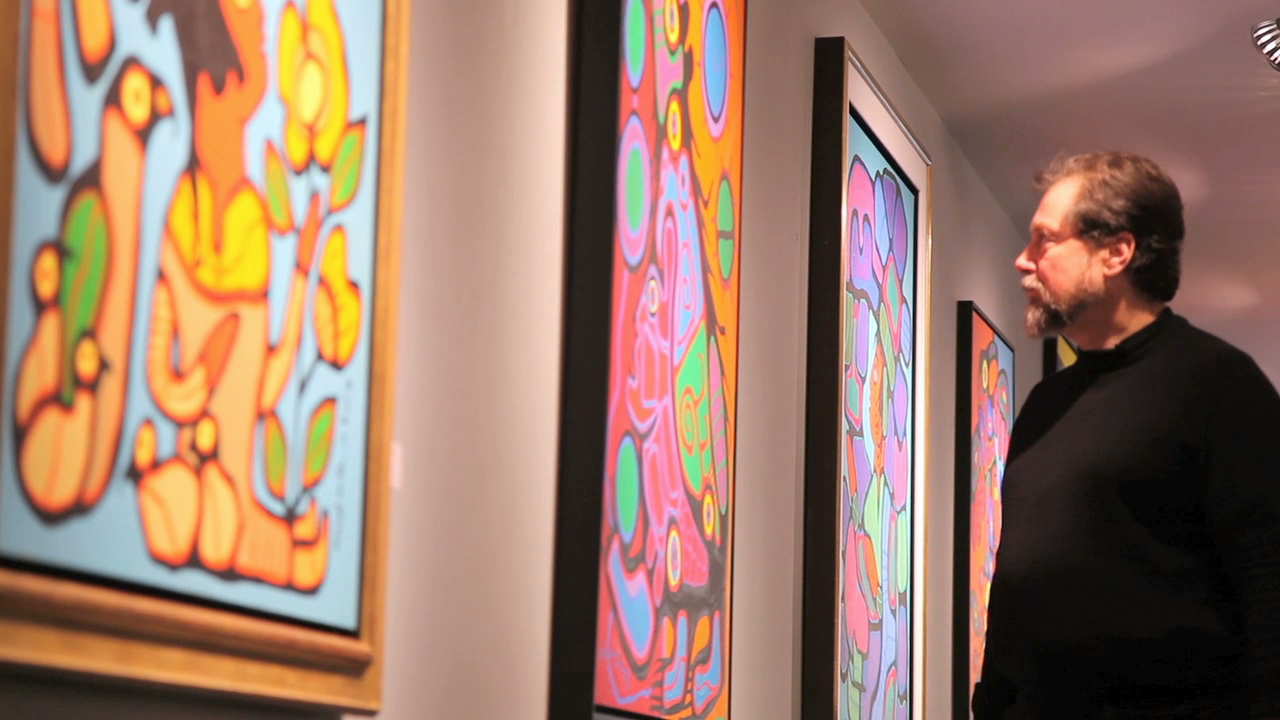
The business challenge
For an esteemed gallery like KRG, lighting wasn’t decoration, it was an obligation. Newman identified gallery aesthetics as their biggest business challenge. With KRG representing only 15 artists (most galleries represent 60), every exhibition had to show those artists’ work in the best possible way.
“If it’s not as beautiful as it can get, people aren’t going to buy it.”
Prior to LED conversion, KRG ran on halogen lamps, a technology Newman never liked.
“Halogen lights are hot, they have UV, and they have obvious hot spots. When you took a photograph, you always had a dark room with spots, and that just exemplified what needed to change.”
The heat and ultraviolet emitted from halogens posed a particular threat in a gallery showing irreplaceable, one-of-a-kind work. Heat carried a fire risk; UV bleached artwork the way it bleaches floors and leather. KRG knew they needed LEDs. The question was when.
The necessary leap
Newman had been reading about LED lighting for years before committing.
“… once we lit the place up with LEDs … it’s a whiter, cleaner light. The whole place has a nicer lighting to it. It’s a broader light that covers the whole work. The yellow light of halogen can be warm and do positive things in the right circumstances, but in general it is diluted. It’s not correct to put finely painted paintings under that light. You should be seeing it under what the artist at least checked his painting under, which is daylight white.”
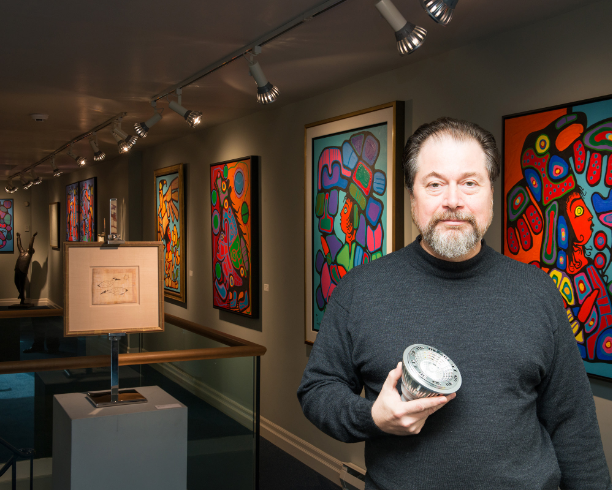
What changed beyond aesthetics
Operational costs
“While I have yet to receive an electricity bill, the fact that I can unscrew a light after it has been on all day lets me know we’re not filling the place with extra heat right there. We know the savings is there.”
Gallery climate
“We did have a heat problem. In the summer, we were putting on our A/C units, because at any given time we have about 60 lamps on in the gallery, and that would just heat the place up enough that at certain times it would just be critical mass.”
Maintenance
“We already know all the time and effort that goes into ordering new bulbs, getting these boxes, where to keep them all. That’s a lot of extra money out just sitting around. We don’t need extras now.”
But Newman was clear that these were secondary
“The bottom line for us is aesthetics; the quality of light. Bringing out all the detail and subtlety in the artwork. It doesn’t matter how beautiful your art is, if people can’t see it properly, it’s not going to sell very easily.”
The gallery’s clients noticed.
“Our clients remark on how beautiful the gallery is. Many don’t realize what has changed; they just know the artwork looks better. And that’s all you can want.”
And on the up-front cost objection
“We looked at results and talked to people. Mostly we looked at technical results, such as replacing a large number of bulbs with LEDs, electricity costs before and after. We definitely knew what the savings were going to be, and we could calculate how ridiculously quick we would see a return on our investment. We have to move them once a month, and with the halogens they would break and we’d have to replace them, so there’s that cost savings too.”
On selecting an LED supplier
Newman’s research turned up a fragmented industry with few real technical standards.
Lumicrest’s approach of handpicking LED sources, testing every fixture against an internal inspection regime, and guaranteeing performance gave Newman the confidence to commit to a full-gallery conversion. A year in, he was unequivocal:
“I’m still waiting for someone to tell me what the really big deficiencies are with LEDs. So far, there’s nothing.”
*This case study was originally produced in 2012, documenting Kinsman Robinson Galleries’ conversion from halogen to LED lighting and their experience showing the work of Norval Morrisseau and other Woodland School artists. Kinsman Robinson Galleries has since closed; this story is preserved as a record of the project, the technical considerations involved, and one gallery director’s account of what changes when serious art is properly lit.*